
🔬 Paramedical Diploma Programme • Siliguri Campus
DMLT Course in Siliguri – Diploma in Medical Laboratory Technology
Build Your Career in Medical Laboratory Technology with NAHI
Learn. Practise. Get Skilled. Build Your Healthcare Career.
The Diploma in Medical Laboratory Technology (DMLT) at Northern Allied Health Institute (NAHI), Siliguri, is designed for students who want to develop practical knowledge and career-ready skills in medical laboratory science and allied healthcare.
Course Code
AHE001
Academic Duration
2 Years
Internship
6 Months
Training Structure
2 Yrs + 6M Intern
Eligibility
10+2 / Equivalent*
Location
Siliguri, WB
*Eligibility is subject to NAHI's officially approved DMLT requirements and document verification.
DMLT Course Overview
The Diploma in Medical Laboratory Technology (DMLT) is an allied healthcare programme that prepares students for laboratory-based work supporting disease diagnosis, treatment monitoring and preventive healthcare. The programme combines medical science foundations with practical laboratory training.
At NAHI, the curriculum covers Clinical Biochemistry, Clinical Microbiology, Parasitology, Haematology, Blood Banking and Histopathology, together with progressive practical laboratory work. Students also learn sample collection and processing, laboratory safety, quality control, documentation, equipment handling and professional communication.
The programme combines classroom learning, laboratory practical training, clinical exposure and a supervised six-month internship. Students develop foundational skills in sample handling, laboratory procedures, diagnostic disciplines, laboratory safety, quality control, documentation, equipment handling and professional workplace practices.
Why Study DMLT at NAHI, Siliguri?
NAHI offers a student-centric environment focused on practical competence, patient-safety ethics, and clinical familiarity across major diagnostic disciplines:
Practical laboratory training across major diagnostic disciplines.
Clinical laboratory exposure and healthcare workflow awareness.
Hands-on orientation to laboratory equipment and diagnostic procedures.
Laboratory safety, biosafety protocols and quality-conscious practice.
Smart classroom and technology-supported digital learning.
Dedicated faculty guidance and close practical supervision.
Structured six-month supervised clinical internship.
Career counselling, interview preparation and placement assistance.
DMLT Course Eligibility
Candidates who have completed Higher Secondary (10+2) or an equivalent qualification may apply, subject to the officially approved NAHI eligibility requirements for DMLT.
Academic Qualification: Higher Secondary (10+2) or equivalent examination from a recognized Board.
Subject Stream: Higher Secondary (10+2) or equivalent — subject to NAHI's officially approved DMLT eligibility requirements and document verification.
Verification: Original document verification is mandatory before final seat allotment.
Age Norms: Age requirements, if applicable, follow current institutional and affiliating guidelines.
Result-Awaiting Candidates: Students appearing for final 10+2 exams or awaiting results can contact the Admission Office for provisional registration.
DMLT Course Duration and Training Structure
The current DMLT structure is presented as two years of academic and practical training followed by a six-month supervised internship.
| Stage | Learning Focus |
|---|---|
| Year 1 | Communicative English and Computer Fundamentals; Clinical Biochemistry I; Clinical Microbiology I & Parasitology; Haematology, Blood Banking & Histopathology I; Practical I–IV. |
| Year 2 | Clinical Biochemistry II; Clinical Microbiology II; Haematology, Blood Banking & Histopathology II; Practical V–VII. |
| Internship | Six-month supervised clinical laboratory internship, subject to current NAHI clinical training arrangements. |
Explore our comprehensive Paramedical Curriculum Framework.
DMLT Course Fees
DMLT fees are structured to be affordable and transparent, adhering strictly to NAHI's latest approved fee structure for the applicable academic session. We do not practice hidden charges.
Detailed schedule covers Admission, Annual Registration, Tuition, and Library access.
Flexible instalment payment plans available to assist deserving students and families.
Complete admission prospectus and cost breakdown shared upfront during counselling.
DMLT Admission Process at NAHI
Admission to DMLT is direct, merit-conscious and counselling-guided. Follow these 7 straightforward steps:
- 1 Choose DMLT and review eligibility: Confirm requirements and course structure.
- 2 Submit an online enquiry/application: Apply online or visit the NAHI campus in Hakimpara, Siliguri.
- 3 Receive academic and career counselling: Discuss lab specializations, clinical scopes and schedules.
- 4 Submit documents for verification: 10th/12th marksheets, ID proof and photographs.
- 5 Complete prescribed admission and fee formalities: Confirm seat allocation.
- 6 Receive official admission confirmation: Welcome kit and enrolment documentation.
- 7 Attend orientation: Begin classroom instruction, laboratory practicals, and clinical exposure.
Curriculum Structure
DMLT Course Syllabus
The curriculum provides balanced theory and progressive laboratory work across all diagnostic disciplines.
First Year Curriculum
Foundation of Laboratory Sciences, Clinical Chemistry & Haematology
| Code | Subject |
|---|---|
| AHE001-01 | Communicative English and Computer Fundamentals |
| AHE001-02 | Clinical Biochemistry – I |
| AHE001-03 | Clinical Microbiology – I & Parasitology |
| AHE001-04 | Haematology, Blood Banking & Histopathology – I |
| AHE001-05 | Practical – I |
| AHE001-06 | Practical – II |
| AHE001-07 | Practical – III |
| AHE001-08 | Practical – IV |
Second Year Curriculum
Advanced Diagnostic Testing, Histological Techniques & Practical Mastery
| Code | Subject |
|---|---|
| AHE001-09 | Clinical Biochemistry – II |
| AHE001-10 | Clinical Microbiology – II |
| AHE001-11 | Haematology, Blood Banking & Histopathology – II |
| AHE001-12 | Practical – V |
| AHE001-13 | Practical – VI |
| AHE001-14 | Practical – VII |
Core Knowledge & Competencies Acquired:
Practical Laboratory Training
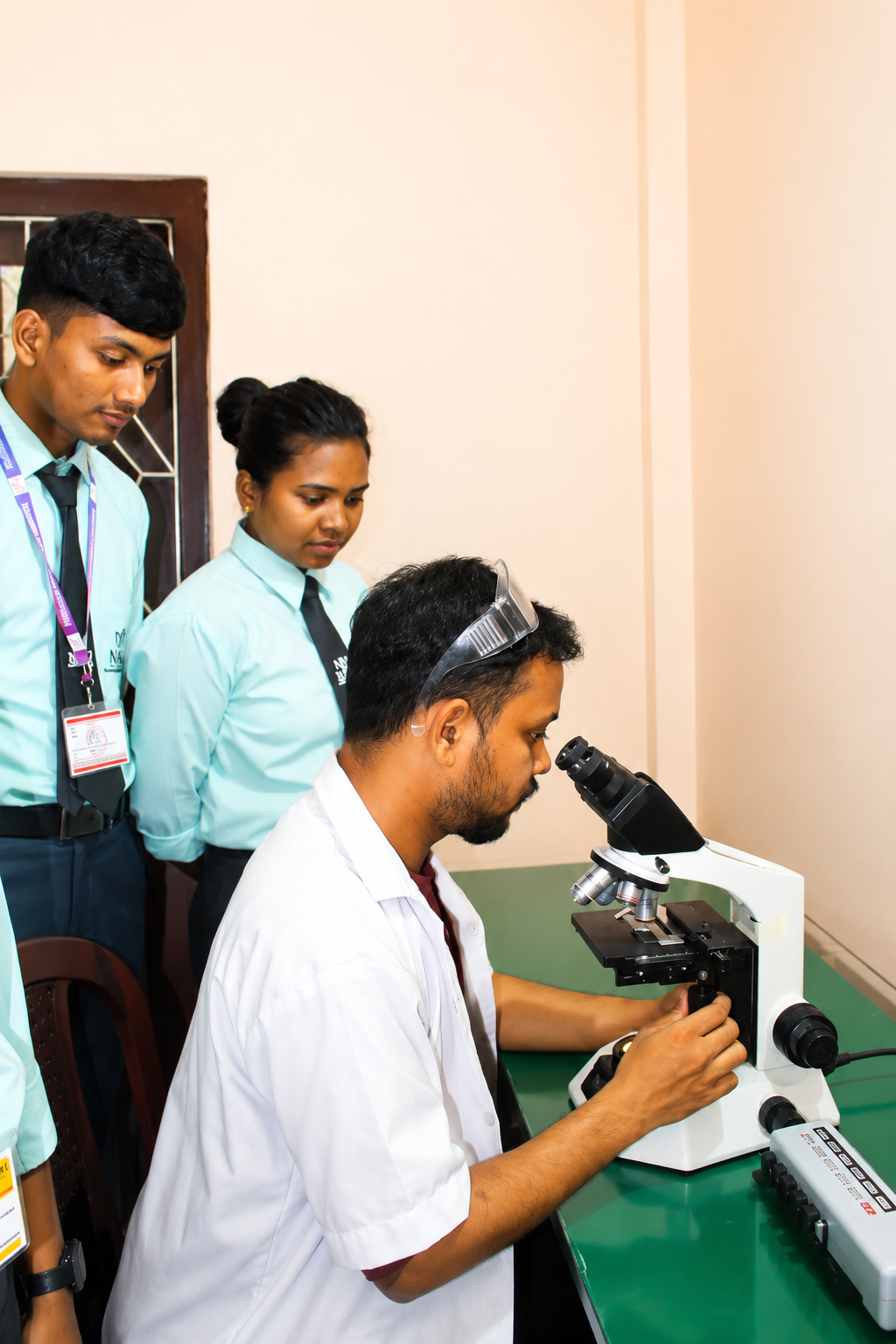
Learn by Doing. Build Laboratory Confidence. Students work with real diagnostic laboratory tools, specimen preparation protocols, and analytical instruments:
- • Microscope handling, lens alignment and microscopic examination
- • Blood sample collection (phlebotomy awareness) and centrifugation processing
- • Clinical biochemistry practical procedures and spectrophotometric analysis
- • Microbiology, staining techniques and parasitology practical exposure
- • Haematology procedures, complete blood counts (CBC), ESR and blood smears
- • Histopathology tissue processing and staining orientation
- • ABO blood grouping, Rh typing and cross-matching orientation
- • Laboratory safety, biomedical waste handling and chemical biosafety
- • Calibration, quality control standards and laboratory report documentation
Safety Note: All practical work is performed under appropriate faculty supervision and strictly within the student's permitted scope of training and institutional safety procedures.
Smart Classroom and Digital Learning
DMLT learning at NAHI harmonizes rigorous laboratory practice with audio-visual teaching, clinical case demonstrations, digital medical resources, and computer-assisted documentation:
Interactive Classroom Teaching
Engaging lectures breaking down complex cellular pathology and biochemical reactions.
Visual Laboratory Demonstrations
High-resolution slide projections, video walkthroughs of specialized assays and protocols.
Digital Learning Resources & Cases
Access to digital reference materials, clinical diagnostic case studies, and medical terminology banks.
Hospital Information & Documentation
Computer fundamentals, laboratory information systems (LIS) basics, and data entry practice.
Hospital Exposure
Clinical Training and Six-Month Internship
Clinical exposure helps students understand diagnostic laboratory workflow in real-world healthcare environments. The current DMLT structure includes a six-month supervised internship following the completion of the 2-year academic coursework.
Biochemistry Workflow
Real-time processing of liver, kidney, cardiac profiles and automated biochemistry analysers.
Microbiology & Culture
Bacterial plating, sensitivity testing, media preparation, and contamination control.
Haematology Services
Routine blood profiling, differential leukocyte counts, coagulation monitoring, and blood banking.
Quality & Safety
Daily control checks, inter-departmental communication, and strict biohazard adherence.
*Clinical internship postings are coordinated subject to active institutional arrangements and student attendance eligibility.
View Internship DetailsScholarship and Financial Assistance
Northern Allied Health Institute believes financial limitations should never deter a dedicated student from pursuing healthcare education. Eligible candidates may access:
Merit-Based Opportunities
Institutional merit concessions for students demonstrating exceptional academic records in 10+2.
Government Scholarship Guidance
Administrative support for state & national student scholarship portals (SC, ST, OBC, Minority, EWS).
Flexible Instalment Support
Tailored term-based payment plans to help families manage educational costs comfortably.
Scholarship availability is subject to verification of supporting documentation and government/institutional guidelines. Contact our admission desk for details.
Skills You Develop in DMLT
Our comprehensive syllabus ensures students develop both practical dexterity and theoretical depth:
Career Opportunities After DMLT
DMLT provides a foundation for laboratory-support and diagnostic healthcare roles. Actual employment depends on qualification requirements, employer criteria, applicable regulations, and individual skill:
Medical Laboratory Technologist
Clinical diagnostics & assays
Pathology Laboratory Technician
Diagnostic pathology units
Blood Bank Technician
Transfusion & blood storage centres
Microbiology Laboratory Technician
Infectious disease analysis
Biochemistry Laboratory Technician
Chemical pathology & analysers
Hospital Laboratory Technician
Inpatient & emergency diagnostic labs
Diagnostic Laboratory Assistant
Commercial diagnostic chains
Research Laboratory Assistant
Life sciences & clinical research
Potential Settings: Hospitals, diagnostic laboratories, pathology centres, blood banks, research laboratories, and public health setups, subject to employer requirements.
Compliance note: DMLT graduates are paramedical/allied health technicians and not doctors or pathologists.
Higher Education After DMLT
Eligible DMLT graduates can explore relevant undergraduate, advanced diploma, certificate or professional development programmes according to the rules of the institution offering the next qualification:
- Relevant B.Sc. / undergraduate allied health programmes (where eligible under university admission rules)
- Advanced laboratory skill programmes in molecular biology, flow cytometry, or advanced immunology
- Specialized diagnostic laboratory certifications in quality management (NABL ISO 15189 awareness)
- Continuing professional development workshops and healthcare administration programmes
Note: NAHI does not guarantee automatic credit transfer or lateral entry without a formal current university agreement.
Career Guidance and Placement Assistance
NAHI provides active career guidance and placement assistance to help eligible students explore employment opportunities across North Bengal, Sikkim, and neighboring regions:
Policy Notice: NAHI provides career guidance and placement assistance to help eligible students explore employment opportunities. Final recruitment decisions are made by employers according to their requirements.
Who Should Choose DMLT?
The DMLT programme is ideal for:
- ✓ Students interested in medical science, diagnostics, and investigative laboratory testing.
- ✓ Students who enjoy precision, hands-on practical work, and detail-oriented technical procedures.
- ✓ Learners passionate about pathology, microbiology, biochemistry, or haematological sciences.
- ✓ Students seeking a career-oriented, job-focused allied healthcare qualification with clinical internship.
- ✓ Candidates comfortable following rigorous laboratory safety, accuracy, and medical documentation standards.
Why Choose NAHI for DMLT?
Northern Allied Health Institute in Siliguri stands out for:
Common Enquiries
Frequently Asked Questions About DMLT
Find verified answers to frequently asked questions regarding DMLT admission, syllabus, eligibility, fees, internship, and career scope at NAHI Siliguri.
What is DMLT?
What is the DMLT course code at NAHI?
What is the duration of the DMLT course?
Who can apply for DMLT?
Is Science compulsory for DMLT?
Does DMLT include practical laboratory training?
Does DMLT include an internship?
What subjects are taught in DMLT?
What skills are learned in DMLT?
What are the career options after DMLT?
Can DMLT graduates work in hospitals?
Can DMLT graduates work in diagnostic centres?
Does NAHI provide placement assistance?
What is the DMLT course fee?
How can I apply for DMLT admission?
Can I pursue higher education after DMLT?
Is DMLT a good career option?
What is the difference between DMLT and BMLT?
Can students from other states apply?
Does DMLT make me a registered medical professional?
Where can DMLT graduates work?
What is taught in practical DMLT sessions?
Have more questions? Browse our full General FAQ Section or reach out directly to our counsellors.
Apply for DMLT Admission in Siliguri
Take the first decisive step towards a respected healthcare career. Enrol in NAHI's Diploma in Medical Laboratory Technology with structured hospital training and dedicated placement guidance.
Campus Location: Sachin Sarkar Sarani Road, Near Baghajatin Athletic Club & 1st Gate of Siliguri College, Hakimpara, Siliguri – 734001